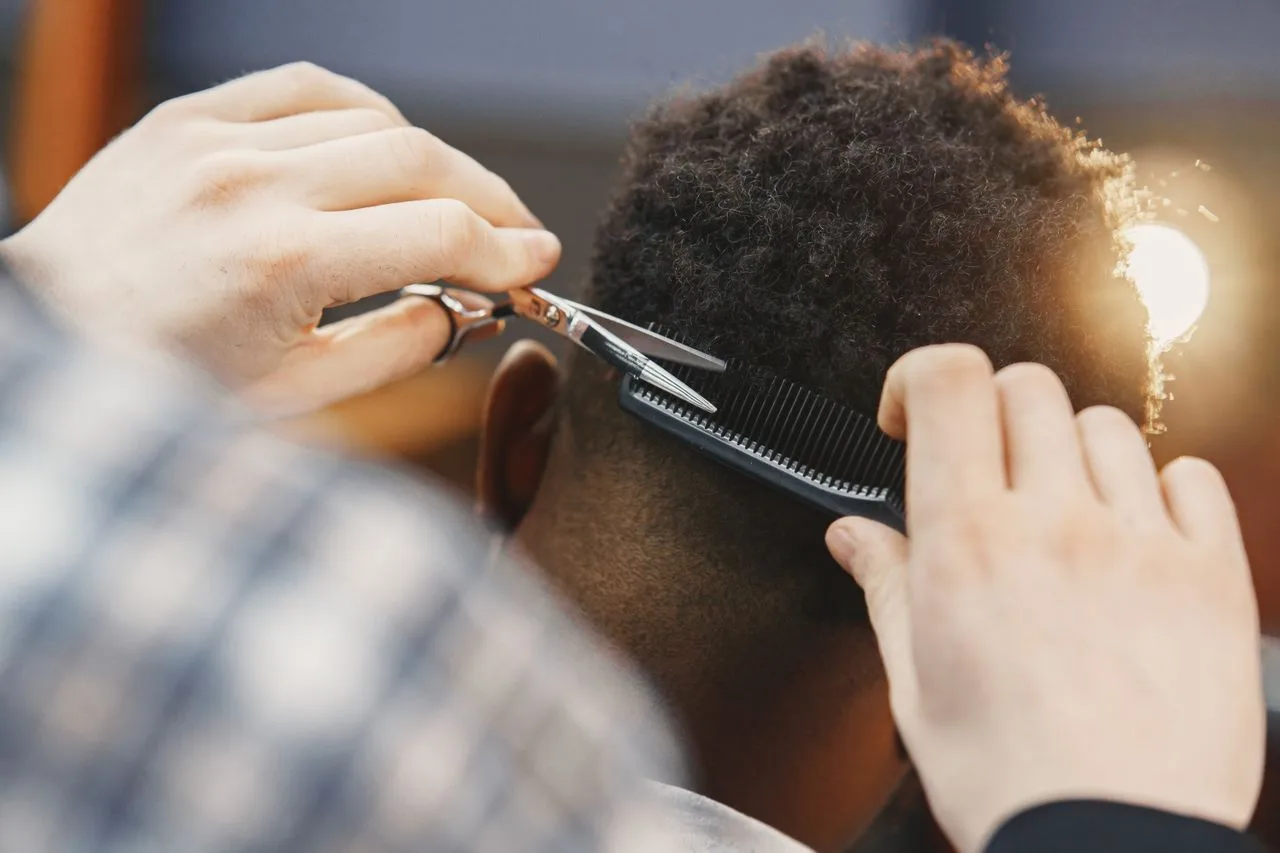
How to get clients to rebook: the one sentence a barber says before they leave the chair
What two weeks of drift costs a barber a year, the moment to ask, the words that get a yes, and booking it as a repeat there and then.
By The Wunderhand team ·
A skin fade grows out in three weeks. Left to himself, the client comes back in five, because life got in the way and he only noticed when it looked untidy. Two weeks of drift, every visit, is the difference between seventeen cuts a year and ten. How to get clients to rebook is not a marketing question. It is one habit, at one moment, every time: book the next one before he leaves the chair.
What the drift costs
Put your own numbers in. A £28 cut every three weeks is about seventeen visits a year, or £476 from one client. The same client at five-week gaps is ten visits, £280. That is £196 a year you did not lose to a competitor — he still comes to you — but to nobody asking.
Now count your regulars. Fifty of them drifting from three weeks to five is close to £10,000 a year, from people who already like what you do. No Instagram post is worth that. The next appointment, booked at the chair, is.
The moment, and the words
Most missed rebookings are not lost because the client did not want to come back. They are lost because nobody asked, and by the time he thinks of it he is already overdue and booking wherever has a slot tonight.
So the ask has a fixed place in the cut: the last minute, mirror up, brushing him off. Same point every time, so it is a habit and not something you remember when the diary looks thin. And it is a specific offer, not an open question:
- "Three weeks — Tuesday the 14th, half nine again?"
- "Beard'll want a tidy in a fortnight. Same time?"
"Shall we get you booked in?" gets "I'll sort it later". A day and a time gets a yes or a different day, and either one is a booking.
Book it there and then, as a repeat
The ask only works if saying yes takes ten seconds. If it means finding the phone, checking a paper diary and promising to text him, the moment has gone.
Wunderhand books the repeat from the appointment you are looking at: same time in three weeks, or whatever his gap is, and it keeps booking the next ones ahead, so his slot is his until he changes it. He gets an email confirmation with a link, and if the 14th turns out to be no good he moves it himself from that link rather than ringing you. You have done nothing but say a sentence.
Two things that make it stick:
- Put the repeat where you want it. If Tuesday morning is your quiet stretch, that is the slot to offer. A regular booked into a quiet hour is a quiet hour sold for the rest of the year — the quiet-days guide is about exactly that, and the barbershop version has the numbers.
- Let the reminder do the remembering. An email a day or two before, with the same link to move or cancel, is what turns a booking made three weeks ago into a client in the chair. Wunderhand sends it. It does not send texts, so if a client only ever reads texts, tell him to expect an email.
"I'll sort it later"
Some will say it, and that is fine. Do not let it drop.
- Offer the rough version instead of the exact one: "I'll leave it three weeks and you tell me the day." Then book it for three weeks on the nearest slot and tell him he can move it — a booking he can move is worth more than a promise to call.
- If he really will not book, his record should show when he is due. Wunderhand works out each client's usual gap from his visits and lists the ones who are overdue, so a quiet Monday morning is a list of names to message rather than a guess.
The whole shop, not just your chair
If you have other barbers, the habit has to be everyone's, or the shop's diary is only as full as its most organised person. Give them the sentence — a day, a time, a gap — rather than a target. Say it in the team chat as client care, which is what it is. And look, every few weeks, at who is leaving without a next booking: a chair with regulars drifting is a chair losing money that no amount of walk-ins gets back.
Write it down this week
- Your usual gaps, by service: three weeks for a fade, four for a scissor cut, two for a beard.
- The sentence, with a day and a time in it, that you will say at mirror-up.
- The quiet hour you will offer first.
What it costs to run the repeats and the reminders — per person, with no cut of your bookings — is on the pricing page, and how the diary works is on the product page.
More from the blog
- No-show policy for braiders: deposits and cancellation windows for a six-hour bookingWhat a no-show really costs a braider, the deposit that answers it, and why the cancellation window should be longer, not softer.19 September 2026
- No-show policy for mobile hairdressers and makeup artists: deposits, travel fees and the wasted journeyA no-show costs a mobile stylist the slot and the drive. The deposit, the travel fee and the cancellation window that cover both.19 September 2026
- Off-peak pricing for a barbershop: what to charge for a quiet Tuesday morningWhat an empty chair costs, an opening price to test for the quiet hours only, and the rules that keep it from turning into a sale.19 September 2026