Off-peak pricing for a barbershop: what to charge for a quiet Tuesday morning
What an empty chair costs, an opening price to test for the quiet hours only, and the rules that keep it from turning into a sale.
By The Wunderhand team ·
A skin fade is £28 and takes half an hour. On a Saturday you do sixteen of them and turn people away. On a Tuesday morning you do three, and the chair sits empty for the other ninety minutes of every hour. Off-peak pricing for a barbershop is the answer to that gap — not a sale, not a discount on everything, but a Tuesday-morning price for the Tuesday-morning chair. Here is how to set one, with the numbers.
What the empty chair is costing
Work it out for one barber and one morning. Say you open at nine, and between nine and twelve on a Tuesday you sell three half-hour slots out of six. Three unsold slots at £28 is £84 a morning. Over a month that is about £360 a barber, for a chair that was open and staffed the whole time.
That is the figure to hold in your head when you decide what to charge, because it is what "doing nothing" costs. And it is the figure a quiet-hour price has to beat: the rule only works if the cheaper slots bring in more than they give away.
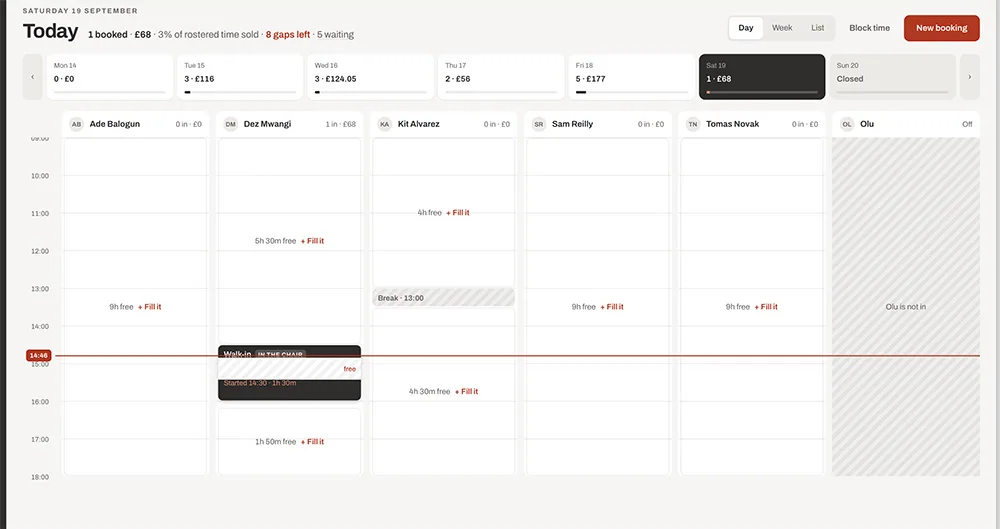
Measure it rather than guess. Wunderhand's quiet-times screen finds the hours that are reliably below your shop's own average — booked minutes against open minutes, chair by chair — and says roughly what the empty time is worth at your take. It also says when it has not seen enough Tuesdays to be sure, which is the honest answer for a new shop.
Pick an opening price, then find out
Nobody can tell you the right percentage from your bookings alone, because a slot that fills at £24 has not proved it would have filled at £26. So you pick an opening number and measure.
A worked example, and only an example: 15% off £28 is £24 — a "£4 less than usual" beside Tuesday morning on your booking page. If that fills two of the three empty slots, you have taken £48 you were not going to take, and given away £4 on each of the three cuts you were getting anyway: £36 up on the morning. If it fills none, the rule cost you £12 on the three regulars and told you the hour is not price-sensitive, which is worth knowing too.
The way to read it: over four or five Tuesdays, is the hour fuller than it was? Wunderhand suggests a starting percentage from how far below your baseline the hour sits — the emptier it is, the bigger the opening bid — and once a rule is on, reports whether the hour is filling rather than treating the new bookings as proof the discount was never needed. That last point matters: a system that removes the discount the moment the hour fills, watches it empty, and puts it back is a system arguing with itself.
Rules that stay in their lane
A price rule is a weekday and a time window, and nothing else changes. Four things keep it from turning into a sale:
- Tuesday and Wednesday mornings, say, nine to twelve. Not "weekdays". The rule exists because those hours are empty; Friday afternoon is not.
- Per barber, if the quiet is per barber. A junior's chair is often the empty one while the owner's is full. Wunderhand lets a rule apply to one person, or one service, rather than the whole shop.
- Never stacked. If two rules could apply, the client gets the better one, not both. A 15% Tuesday rule and a 10% new-client offer is 15%, not 25%.
- Never below what the cut is worth to you. The rule is a price, so set it like one. If £24 is the least you would ever cut hair for, that is the floor.
Show it, or just charge it
Two ways to present a quiet-hour price, and it is your call per rule. One: the client sees £24 beside Tuesday at ten and £28 beside Saturday, with the saving spelled out — "£4 less than usual". That pulls the price-sensitive client towards Tuesday, which is the point. Two: the client simply sees £24 on Tuesday with nothing said, which reads as the price rather than as a deal. Regulars who never look at the price will not notice either way; the ones choosing between two mornings will. Wunderhand shows the saving beside the time when you turn that on, and just the lower price when you do not.
The habits that do the rest
Price is half of it. At the till, book the next cut into the quiet hour before he leaves: "Same again in three weeks — Tuesday at half nine?" Wunderhand can put that in as a repeat there and then, so the slot is sold before he is out of the door. And keep the waiting list: the man who said "any weekday morning" is exactly who a cancelled Tuesday slot should go to, and the list offers it to him first.
What none of this touches is Saturday. The point of a Tuesday price is that Saturday stays £28 and stays full.
Write it down this week
- The hours that are actually quiet, chair by chair, from your bookings.
- An opening price for those hours — 10% to 25% off, depending how empty they are — as a number to test, not a decision.
- Whether the client sees the saving, or just the price.
For the principles behind all of it, see the general guide to quiet days. What Wunderhand costs to run it — per person, no cut of your bookings — is on the pricing page, and how the quiet-hours pricing works is on the product page.
More from the blog
- No-show policy for braiders: deposits and cancellation windows for a six-hour bookingWhat a no-show really costs a braider, the deposit that answers it, and why the cancellation window should be longer, not softer.19 September 2026
- No-show policy for mobile hairdressers and makeup artists: deposits, travel fees and the wasted journeyA no-show costs a mobile stylist the slot and the drive. The deposit, the travel fee and the cancellation window that cover both.19 September 2026
- Filling a quiet midweek for a braider: the waiting list, repeat bookings and a Tuesday priceA quiet Tuesday is a whole day for a braider. The waiting list, the next appointment booked before she leaves, and a midweek price on the long installs.19 September 2026