Filling a quiet midweek for a braider: the waiting list, repeat bookings and a Tuesday price
A quiet Tuesday is a whole day for a braider. The waiting list, the next appointment booked before she leaves, and a midweek price on the long installs.
By The Wunderhand team ·
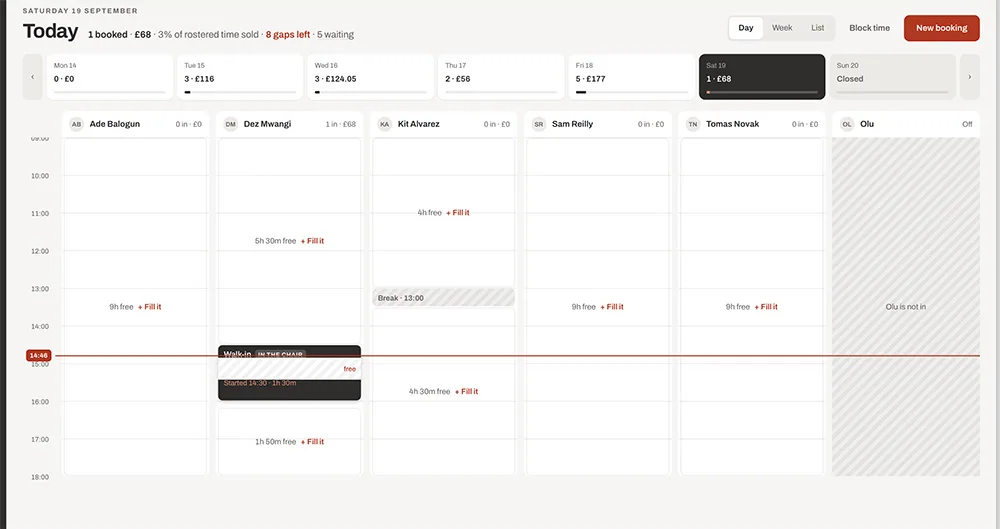
A quiet Tuesday for a barber is a few empty half-hours. A quiet Tuesday for a braider is a whole day — £180 of knotless install that nobody booked, and nothing you can do at ten in the morning to sell six hours starting at eleven. Filling a quiet midweek for a braider is a different problem from filling a barber's chair, and it needs different tools: a waiting list that knows people's days, the next appointment booked before she leaves, and a midweek price on the long installs only.
Why the midweek is empty, and why that is expensive
Braids are booked around the client's week, not yours. People want the Saturday because they have the Saturday. So the weekend is full months ahead and Tuesday to Thursday sit half empty — and because one booking is a whole day, one empty Tuesday is not a slow morning, it is £180 of work you cannot make up.
Put your own number on it. Two empty weekdays a week at one install each is roughly £1,400 a month of days you were open for. That is the figure a midweek plan has to move.
The waiting list is your best tool, not your last resort
For long work the waiting list matters more than it does for anyone else, because a cancelled Saturday is a whole day's money if the right person hears in time — and because the people who can come midweek are already known to you, if you write it down.
Ask everyone who books what days would suit them, and keep it. Shift workers, students, anyone on maternity leave, retired regulars, people working from home: a good share of your clients could do a Wednesday if a Wednesday was offered. Wunderhand's waiting list records each person's days and times of day; when a gap opens, it offers the slot to the people it fits, by email, and the first to book has it. A Tuesday that came free on Sunday night can be sold by Monday morning without you sending a single message.
Book the next one before she leaves, into the midweek
Braids come out on a schedule. Six weeks, eight weeks — you know it better than she does. So the moment to sell the next appointment is while she is still in the chair, and the slot to sell is the midweek one: "Same again in six weeks — I've got Wednesday the 14th, shall I put you in?" A concrete offer gets a yes where "let me know when you want to rebook" gets a message in nine weeks asking for a Saturday.
Wunderhand books the repeat there and then — same time in however many weeks — and keeps booking ahead, so the midweek is sold before the client has left. It is the cheapest fill you will ever make, because it costs no discount at all.
A midweek price on the long installs, and nowhere else
For what is left, a price for the quiet days, on the long services only. Not a sale, not the whole menu: a Tuesday-to-Thursday price on the installs that take the day.
A worked example, and only an example: 10% off a £180 knotless install is £162 — "£18 less than usual" beside a Wednesday on your booking page. If it moves one client a month from a Saturday you would have filled anyway to a Wednesday you would not, you have sold a day for £162 and freed a Saturday to sell at £180. If it moves nobody, it cost you £18 on whoever would have booked a Wednesday regardless, and told you price is not what keeps them away.
Keep it small. Long work is priced on skill and hours, and a client who sees 25% off starts to wonder what the £180 was for. Ten to fifteen percent, on the quiet days only, on the long services only, and measured over a couple of months rather than a couple of weeks — because at one booking a day, two weeks is nothing to go on. Wunderhand applies the rule to those days on your booking page, shows the saving if you want it shown, and reports whether the days are filling; the quiet-times screen will also tell you honestly when it has not seen enough weeks to say.
The deposit still applies
A midweek booking sold at a lower price is still a six-hour booking with the hair bought in. Everything in the braider's no-show policy applies: the deposit at booking, the longer cancellation window, the sentence that explains both. A discounted day that then does not turn up is the worst of both.
Write it down this week
- Which weekdays are actually empty, from your bookings over the last couple of months.
- Every client's "days that suit me", on the waiting list.
- The sentence you will say at the end of every install to book the next one midweek.
- A midweek price on the long installs only, 10% to 15%, as a number to test.
For the principles behind all of it — finding the quiet hours, the two levers, what not to do — see the general guide to quiet days. If you braid from home, the rules and the waiting list sit on your own page; what it costs, per person and with no cut of your bookings, is on the pricing page.
More from the blog
- No-show policy for braiders: deposits and cancellation windows for a six-hour bookingWhat a no-show really costs a braider, the deposit that answers it, and why the cancellation window should be longer, not softer.19 September 2026
- No-show policy for mobile hairdressers and makeup artists: deposits, travel fees and the wasted journeyA no-show costs a mobile stylist the slot and the drive. The deposit, the travel fee and the cancellation window that cover both.19 September 2026
- Off-peak pricing for a barbershop: what to charge for a quiet Tuesday morningWhat an empty chair costs, an opening price to test for the quiet hours only, and the rules that keep it from turning into a sale.19 September 2026